
Lop-eared rabbits confirmed at highest risk of hidden ear disease in new RVC study
A new study led by the Royal Veterinary College (RVC) has verified that lop-eared rabbits are more prone to hidden and potentially painful ear disease. The findings address evidence gaps from previous research and highlight the importance of routine veterinary otoscopic ear checks to help owners protect the health and wellbeing of pet rabbits.
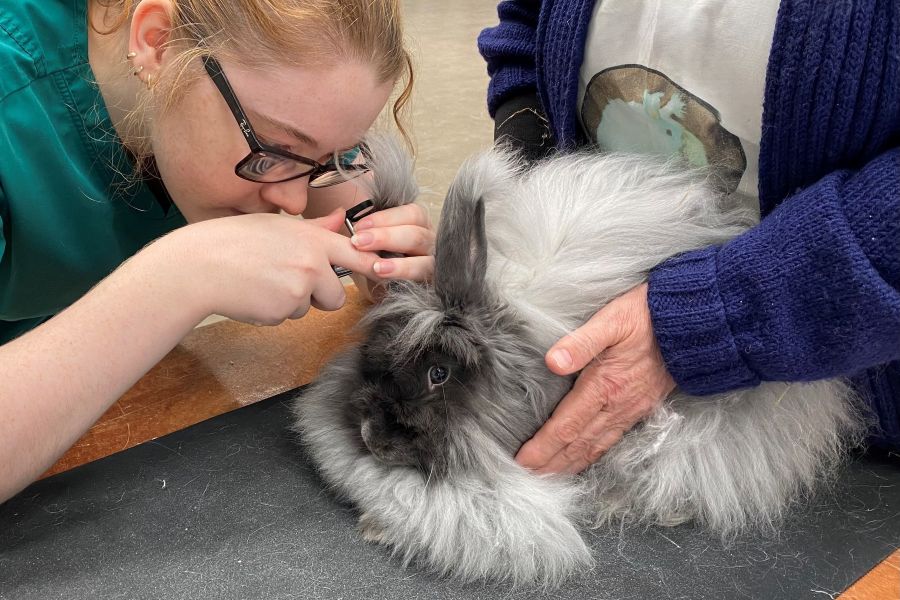
Ear disease is widely recognised in rabbits, but many problems can go unnoticed because rabbits rarely display clear signs of discomfort. In particular, issues like excess ear wax, narrowing of the ear canal or the early stages of an ear infection can stay completely hidden unless the ear canal is examined with veterinary equipment.
Although previous research has suggested that lop-eared rabbits may be more susceptible, these studies relied on small samples, retrospective clinical records or owner reports. By conducting a large, systematic assessment of how ear shape and head shape relate to ear abnormalities, this study provides veterinarians and owners with a more robust and nuanced understanding of the condition.
Conducting the study, RVC Rabbit Welfare Research Assistants, Maria Jackson and Michaela Betts, examined 435 pedigree rabbits volunteered by British Rabbit Council (BRC) breeders. Between October 2023 and February 2024, the team travelled to BRC shows and breeding studs to record each rabbit’s ear type, head shape, estimated adult bodyweight, age and other features before performing a structured otoscopic examination. This involved assessing the outer ear, a small inner ear pocket called the diverticulum and the full length of the external ear canal for signs of inflammation, narrowing, discharge or crusting. By combining these detailed observations with multivariable statistics, the team was able to compare ear health across 49 breeds and identify which conformations were most strongly associated with specific ear abnormalities.
The results show that ear shape plays a central role in predisposing rabbits to hidden ear disease. Lop-eared rabbits were more likely to show 9 of the 11 abnormalities assessed, including ear canal narrowing, abnormal colour, flaky and wet discharge, behavioural reactivity to ear examination, dermatological changes to the pinna and crusts in the diverticulum. These abnormalities can indicate painful inflammation or infection in the outer ear canal, which can have a serious impact on a rabbit’s welfare.
The shape of a rabbit’s head was also associated with the types of ear problems they were likely to develop, but not in a consistent manner. Brachycephalic rabbits, which have short and flat skulls, had narrower ear canals, while dolichocephalic rabbits, which have longer skulls, were more likely to have crusts in the diverticulum. Body size mattered too, with heavier rabbits more likely to show problems such as redness, narrowing, flaky discharge and traumatic pinna changes, as well as stronger behavioural reactions during examination. Other physical and signalment factors showed mixed results, highlighting the complexity of ear health across breeds.
Importantly, the study provides clear evidence that certain rabbit conformations pose significant hidden welfare risks, offering a stronger foundation for both breeding and clinical decisions. For breeders, the findings highlight the need to avoid breeding from rabbits with ear canal redness, crusting, bleeding or early narrowing or whose parents had this, while for vets and owners, the study reinforces the importance of routine otoscopic examinations, as early detection can prevent chronic inflammation, discomfort and self-trauma.
Maria Jackson, Rabbit Welfare Research Assistant at the RVC, Registered Veterinary Nurse, and lead author on the paper said:

“Our findings have once again shown that rabbits with lop ears are more likely to develop ear problems – specifically, signs of otitis externa – than rabbits with upright ears. Rabbit owners should take their rabbit for regular veterinary examinations, where the ears will be checked with an otoscope for hidden signs of disease. Anyone owning a lop-eared rabbit must be especially vigilant for subtle signs of ear pain, such as scratching the ears or shaking the head more than normal, and general lethargy or withdrawal.”
Dr Charlotte Burn, Associate Professor in Animal Welfare and Behaviour Science at the RVC, and senior author on the paper, said:
“This is the first study to have directly and systematically examined rabbit ears outside a clinical context, and it confirms that the seemingly endearing shape of lop rabbits’ ears really do risk deeper ear disorders. Alongside the physical changes we observed, we documented rabbit behaviour, such as avoidance, shaking their heads and scratching at their ears, and found that the lop-eared rabbits reacted significantly more to having their ears examined than rabbits with ‘up’ ears. To me, this indicates that their ears were not only physically affected, but they also hurt more, highlighting the animal welfare burden of this hidden problem.”
Julian Kupfer, Chair of Trustees at the British Veterinary Association’s Animal Welfare Foundation, said:
“This is another excellent paper from these authors which once again furthers our clinical knowledge of rabbits and shows the invaluable nature of proper research. Consequently, the results are significant for the veterinary profession and owners when it comes to the health and welfare of rabbits.”
Nadja Hale, Head of Fundraising at the Royal Veterinary College’s Animal Care Trust, said:
“Supporting research like this is central to the work of the RVC Animal Care Trust. These findings not only deepen scientific understanding of rabbit health, but also equip the veterinary community and owners with practical insight that can meaningfully improve welfare on a national scale.”
This study was funded by the British Veterinary Association’s Animal Welfare Foundation and the Royal Veterinary College’s Animal Care Trust.
Notes to Editors
References
- A. Jackson, M. Betts, J. Hedley & C. C. Burn, Rabbit conformational predispositions to ear abnormalities: field study of a pedigree population, The Veterinary Journal, https://doi.org/10.1016/j.tvjl.2025.106497
The full paper can be accessed at: https://doi.org/10.1016/j.tvjl.2025.106497
For media enquiries, please contact:
- rvc@plmr.co.uk
- Press Line: 0800 368 9520
About the RVC
- The Royal Veterinary College (RVC) is the UK's largest and longest established independent veterinary school and is a Member Institution of the University of London.
- It is one of the few veterinary schools in the world that hold accreditations from the RCVS in the UK (with associated recognition from the AVBC for Australasia, the VCI for Ireland and the SAVC for South Africa), the EAEVE in the EU, and AVMA in the USA and Canada.
- The RVC is ranked as the top veterinary school in the world in the QS World University Rankings by subject, 2025.
- The RVC offers undergraduate and postgraduate programmes in veterinary medicine, veterinary nursing and biological sciences.
- The RVC is a research-led institution, with 88% of its research rated as internationally excellent or world class in the Research Excellence Framework 2021.
- The RVC provides animal owners and the veterinary profession with access to expert veterinary care and advice through its teaching hospitals and first opinion practices in London and Hertfordshire.