

Impact of systemic factors on tendon health in the context of exercise, disease and nutritional supplementation: towards avenues for improved diagnosis and treatment
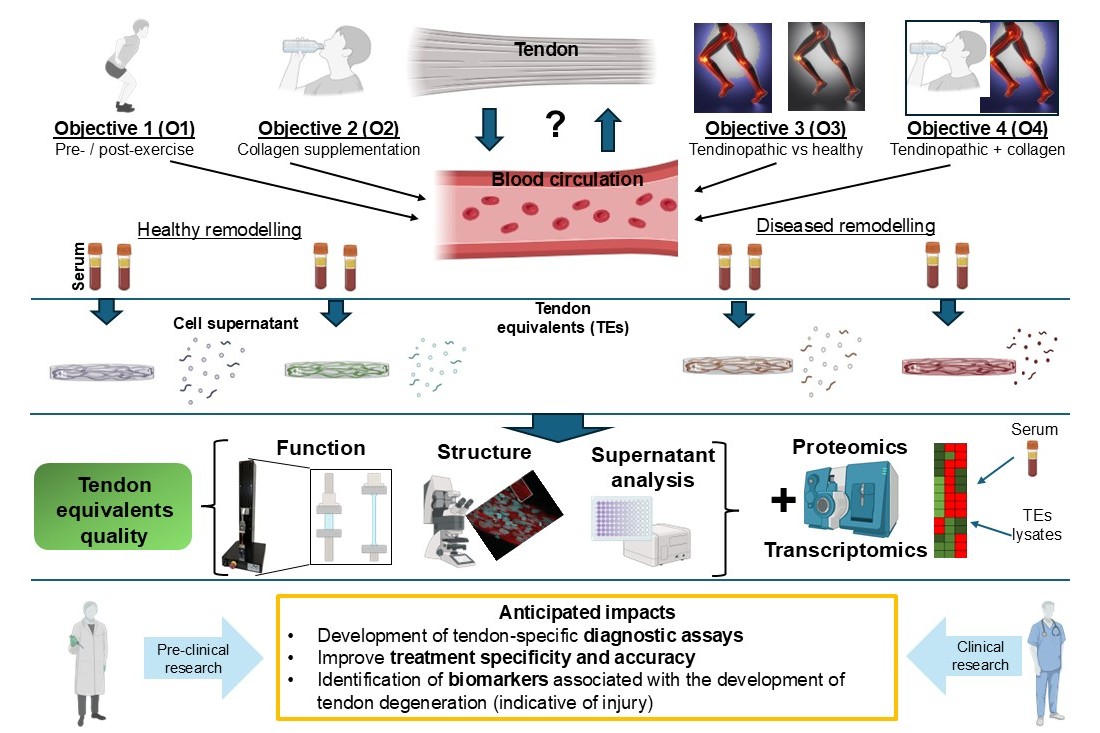
Tendon injuries are common and difficult to treat. In this project, we will establish how circulating factors in the bloodstream are able to regulate tendon health under a variety of conditions
Challenge
Tendons connect muscle to bone, playing a vital role in movement. Tendon injuries (tendinopathies) are common in both inactive and active individuals. Once injured, long-lasting pain and loss of function frequently continue for many months and injuries often recur. Knowledge of early-stage injury progression in humans is limited, as injuries generally reach the clinic after they have become chronic with distinct structural damage. Current diagnostic methods, mainly physical examination and imaging, have limited sensitivity in detecting early structural changes associated with injury. Thus, detecting tendon damage at early stages and improving current diagnostic approaches are of the utmost importance to manage tendinopathies, but currently this is not realistic.
Blood supply is important for tendon health, and factors released into the bloodstream can affect tendon strength. For example, factors released into the blood by healthy conditions such as exercise or collagen supplements can strengthen tendons, whereas those released by diseases like diabetes and pollen allergy, are linked to increased incidents of tendon injuries. In addition, specific markers in the blood can be distinguished in tendinopathic patients and are absent in healthy individuals, but the role of these markers in disease progression is still unknown. Overall, it is not clear how blood factors are able to regulate tendon health and understanding this may lead to the development of more specific and targeted rehabilitation methods.
Solution
Evaluating how tendon cells respond to these factors in the bloodstream in both healthy and diseased conditions could help us understand tendon injuries better. This knowledge is important to detect early signs of tendinopathy and develop targeted treatments. However, assessing the above in patients can be challenging mainly due to practical concerns, for example frequent tendon biopsies are high risk due to the tendon's low ability to heal. An alternative is use of tendon equivalents, which are made in the laboratory and consist of tendon cells which can form their own structure which mimics that of tendon, offering an excellent opportunity to isolate and investigate the tendon’s specific responses under normal and diseased conditions. This program of research aims to understand how tendon cells respond to factors in the bloodstream by examining the quality of cell-built tendon equivalents that have been treated with blood serum from differaent conditions, including after exercise or collagen supplements, and from patients with tendon injuries. In addition, by comparing healthy and diseased conditions, the study will identify factors involved in tendon injuries.
Impact
This will help us learn how blood factors affect tendon health. Additionally, the study will analyse blood serum from patients with chronic tendinopathy to find potential early signs of tendon injuries or possible treatment targets.
Long-term, this proposal will help to develop diagnostic tools for identifying markers in the bloodstream associated with the development of tendon injury. Therefore, the early stages of injury could be detected by regular blood testing with a more accurate and easily accessible method, benefiting patients suffering from tendon injuries.
Partners
Funder - Arthritis UK
Mandy Peffers, University of Liverpool
University of Copenhagen
Loughborough University